
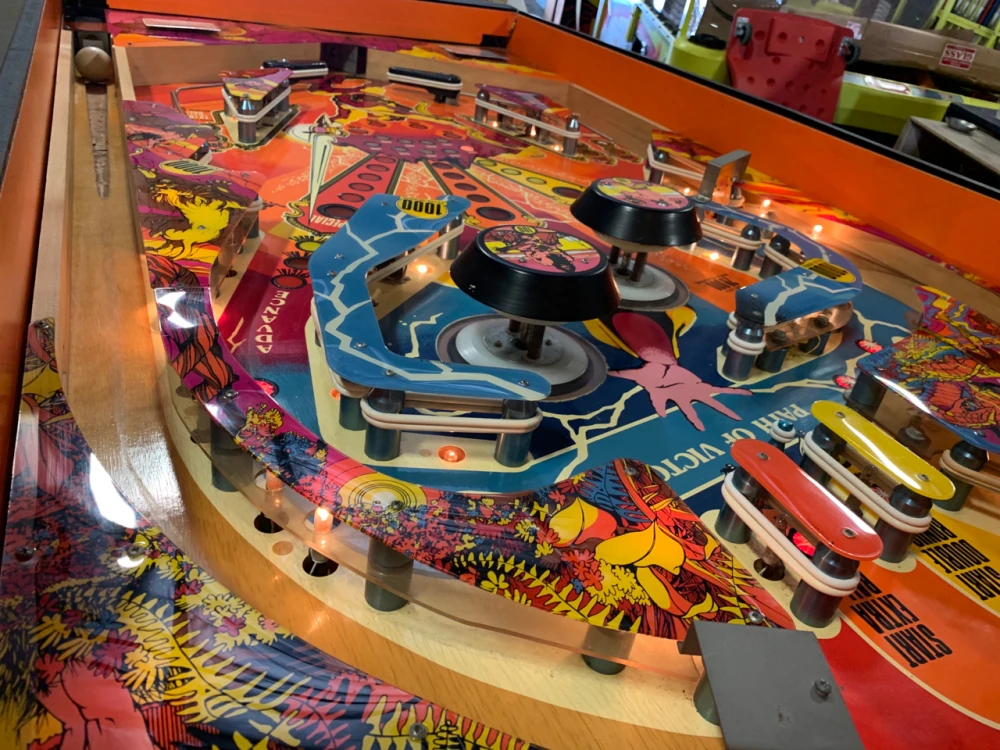
Pinball machines are mostly built to one scale. Atari’s Hercules threw that out. The 1979 cabinet stood seven feet tall, eight feet long, and three and a half feet wide, and it was played with a pool cue ball.
It started as a Bally prototype that did not survive
In 1976, Ron Halliburton of Arcade Engineering came up with a jumbo-sized pinball concept for Bally. Bally built two prototypes of an electro-mechanical version called Bigfoot and decided not to put it into production. According to Allan Reizman, Bally’s engineering lab supervisor, the vibration and stress on the oversized parts caused the game to shake itself apart.
That should have been the end of it. It was not, because Gene Lipkin, a former Halliburton employee, believed the idea had potential. Bally sold the Bigfoot concept to Lipkin’s employer, Atari.
Atari had to engineer parts that did not exist
Atari’s Steve Bicker redesigned the game, Jim Kelley painted the artwork, and Steve Taylor ran the project. Taylor made the call that gives Hercules its personality: a pool cue ball instead of a standard pinball. A normal ball would have looked lost on a playfield that size, and it would likely have slipped underneath the extra-large flippers.
Everything else had to scale up too. Taylor modified washing machine solenoids to drive the flippers, the thumper bumpers, and the slingshots. Atari added shock-resistant components and reinforced the electrical connections to survive the vibration that had wrecked Bally’s prototypes. Bicker later described Taylor as an engineering genius who had to design parts that did not exist yet.
Built for amusement parks, painted like it
Hercules was meant for amusement parks rather than bars, so it had to be loud and bright. Bicker remembered being told to use circus colors, which in practice meant as much orange and purple as the design could take. The artwork draws on Greek myth, with imagery that looks like nods to the Labors of Hercules, including a serpent, Amazon warriors, a centaur, and the Nemean Lion.
How many were made is still an argument
Hercules was the last of only seven pinball machines Atari ever sold commercially. Historians argue about the exact production count, but they agree that no more than 500 reached the market. It is also credited as the largest pinball machine ever commercially produced.
Why it is a good story
Scale is never free. Make a pinball machine dramatically bigger and you do not just get a bigger playfield. You get new forces on every part, which is how Bally’s prototype ended up shaking itself apart, and why Atari had to rebuild the machine from the solenoids up.
Source: The Strong National Museum of Play, Hercules the Pinball Legend.